

The lie was told once. Everything it purchased had to be maintained.
Emperor, someone is avoiding the person reviewing this case.
Not because the investigator has uncovered everything—but because they have returned to a statement that was supposed to remain buried inside the past.
The witness remembers the larger performance.
They remember how they presented themselves.
They remember being believed.
They remember what they received afterward.
But they cannot reconstruct one critical part of the story with the same certainty.
That missing piece concerns how a relationship actually ended—and who abandoned whom.
The witness thought the old statement was finished.
It wasn’t.
A sworn statement does not disappear when the hearing ends. It remains fixed while memory, alliances and later explanations continue moving.
That is now the problem.
The witness has repeated the story for so long that the performance became easier to remember than the original sequence of events.
But the record preserved the earlier version.
Someone is returning to it.
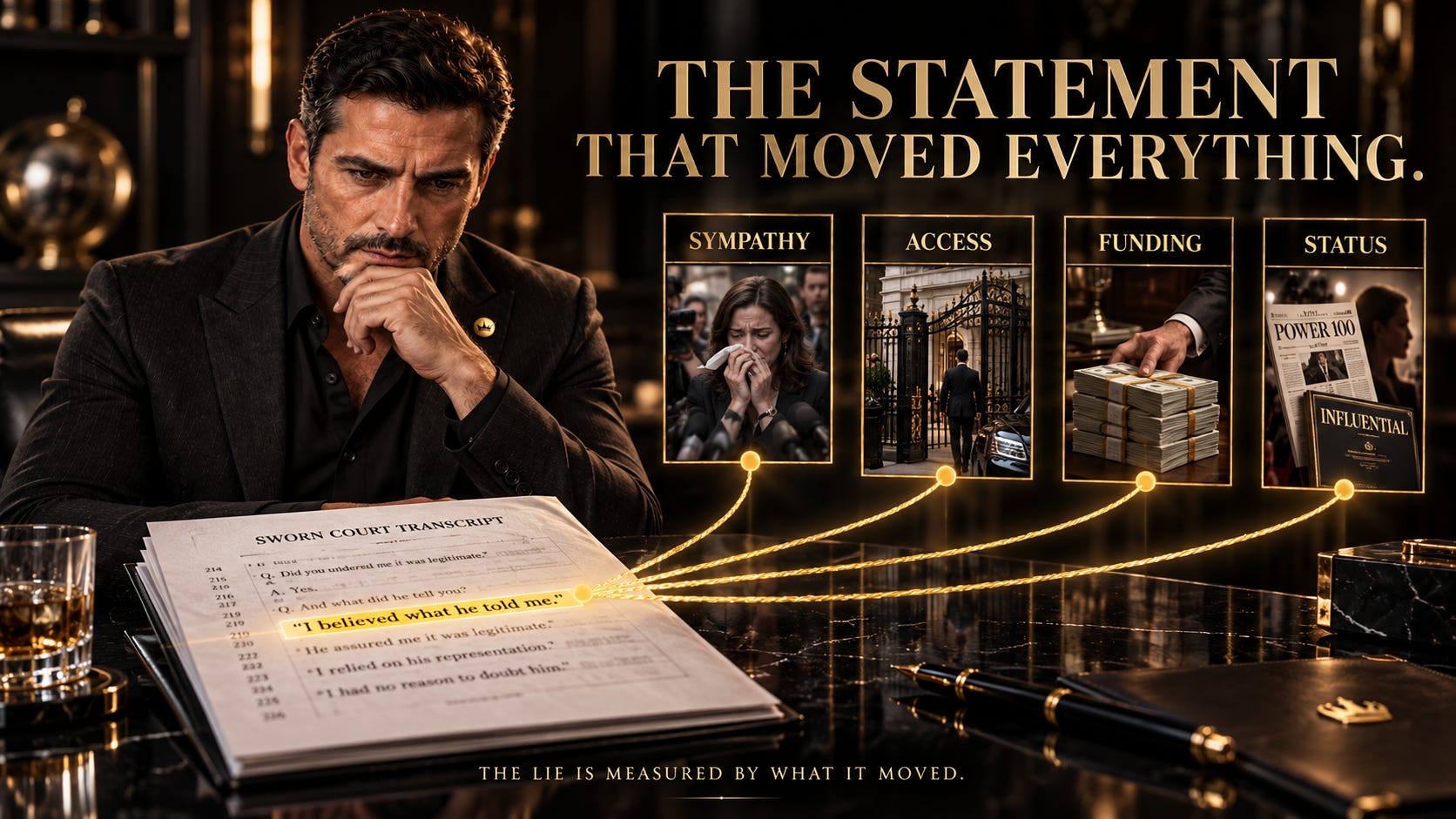
This was not merely a lie. It was a moving instrument.
The statement appears to have produced consequences.
It generated sympathy.
It changed how a second person was perceived.
It brought people together around the witness.
It may have opened access to financial support, professional relationships, status or a protected community.
That is why the statement matters now.
Investigators should not examine only whether the words were inaccurate. They should examine what moved because those words were accepted.
The sequence indicated by the reading is:
Statement → Sympathy → Access → Funding → Status
The statement became the foundation of a new position.
And once that position existed, the witness had to continue behaving as though the original story were true.
The forgotten detail may be the structural detail.
The reading repeatedly returned to one cup—one memory, one account, one fact the witness could not comfortably retrieve.
It concerns the ending.
The public account appears to have said:
I was abandoned.
But the underlying sequence may show:
I left—and concealed why I left.
That omission would not be minor.
It would reverse the moral identity of the entire event.
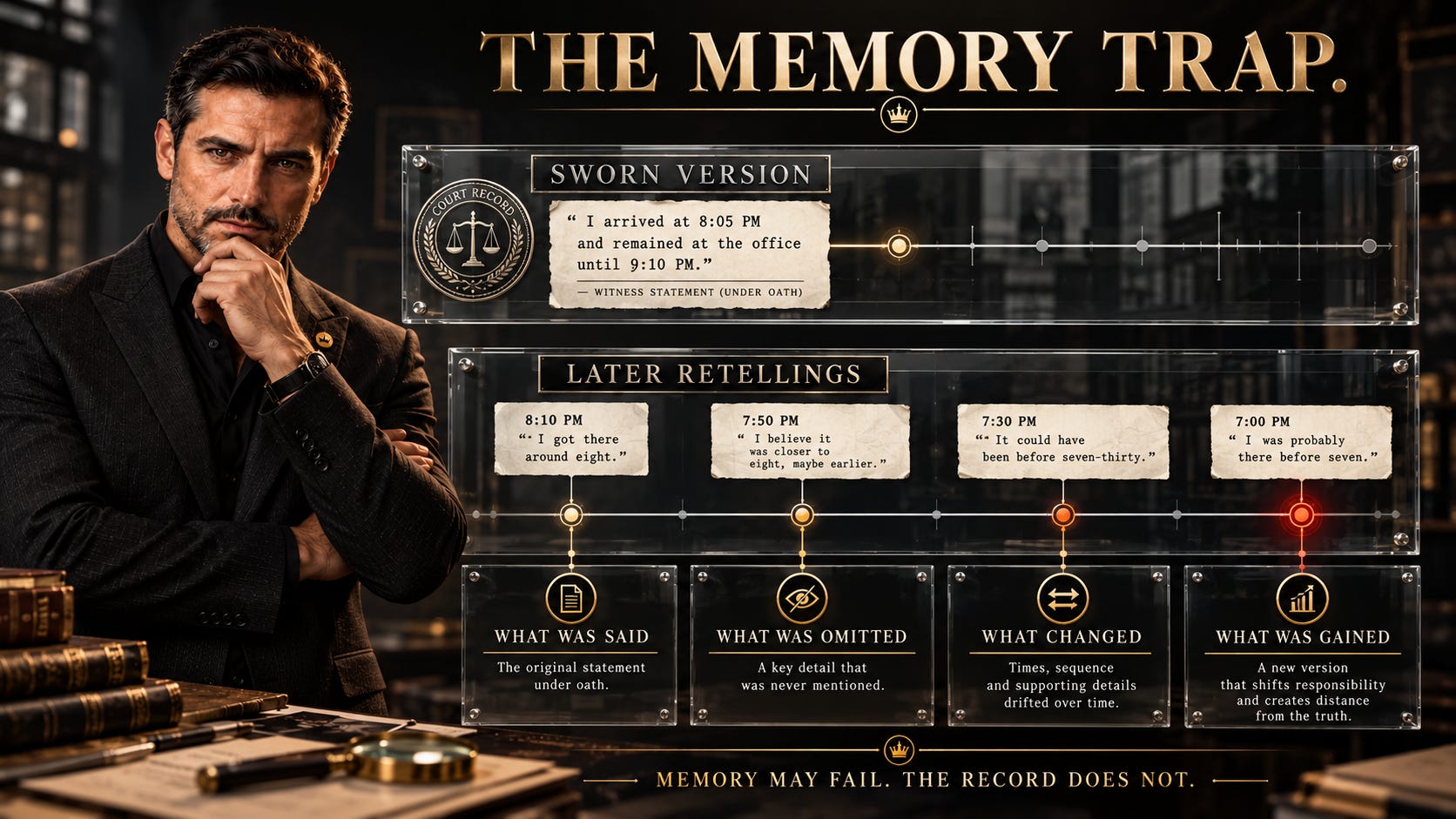
Memory can legitimately change. Trauma, time and ordinary human error can produce inconsistencies.
An inconsistency alone does not prove perjury.
The question is whether the witness knowingly gave a materially false statement—and whether independent records contradict it.
But this witness has a second problem:
The story may have drifted, while the benefits created by it remained measurable.
© 2026 Claudia Quiana. All rights reserved.
This teaching, decode, written framework, original terminology, charts, visual instruments, and arrangement are proprietary materials of Claudia Quiana and Basira Intuition TV.
No part may be copied, reproduced, republished, distributed, recorded, adapted, taught, or used commercially without prior written permission. Paid access is licensed solely for the subscriber’s personal use and does not authorize redistribution or republication.
Brief quotations may be used with clear attribution and a direct link to the original publication.


