

The Trojan horse is not coming. It has already been delivered. And the people celebrating the capture have not yet understood what they brought inside.
This prophecy did not begin on a battlefield.
It began at an altar.
Before Israel lost the Ark, before the Philistines carried it into the temple of Dagon, and before an enemy’s god fell on its face, there was already corruption inside the house entrusted with the sacred thing.
That matters, Emperor, because this warning is not only about an enemy outside the gate.
It is about what happens when the people responsible for protecting a system begin consuming the very thing they were appointed to protect.
It is about corrupted authority.
It is about a successor already standing inside the old order.
And it is about a possession that becomes dangerous the moment it is taken by the wrong hands.

The warning begins at the head.
Eli’s sons, Hophni and Phinehas, held sacred office—but they treated offerings as personal property. They took what had not been given to them. They used their position to satisfy themselves, and the mechanism created to receive sacrifice became a mechanism of extraction.
Eli knew.
He spoke to them, but he did not restrain them.
This is the first judgment in the prophecy: leadership is not judged only by what it personally does. Leadership is also judged by what it knowingly permits to continue.
The sons committed the acts, but judgment was pronounced against Eli’s house.
Why?
Because corruption at the bottom becomes institutional corruption when the head knows and refuses to remove it.
A weak rebuke is not restraint.
Disappointment is not accountability.
Private disagreement does not absolve the authority that continues allowing the public harm.
Emperor, look at the system around you.
Who is actually committing the act?
Who knows it is happening?
Who has the authority to stop it?
And who benefits from appearing concerned while leaving the mechanism untouched?
The person performing the corruption may not be the highest target of the judgment. The higher target may be the authority that kept the corrupted person in position.
Silence may mean succession.
In Samuel’s time, divine revelation had become rare.
The institution still existed. The garments were still being worn. The ceremonies still continued. But the word was no longer moving through the old structure as it once had.
Do not mistake that silence for abandonment.
Sometimes silence is the interval between an expired authority and the voice being prepared to replace it.
Samuel was already inside the house.
He had been placed near the corrupted system, but he had not become part of its corruption. He learned the structure without inheriting its appetite. He served inside the sanctuary while remaining available to a voice the old order could no longer hear clearly.
Then Allah called him directly.

At first, Samuel believed Eli was calling him.
That is important.
The new voice may initially mistake its calling for an instruction from the old authority. It may run back to the institution several times before it understands that the voice is coming from somewhere higher.
Eli could teach Samuel how to answer the call.
But Eli could not control what the call would say.
And the first message Samuel received was a judgment against the very house that trained him.
This is how succession often enters:
The successor is educated inside the old order.
The old order helps the successor recognize the voice.
Then the voice gives the successor a message the old order does not want to hear.
The mechanism cannot atone for itself.
The judgment against Eli’s house contained a terrifying principle: its corruption would not be repaired through the ordinary mechanism of sacrifice and offering.
Why?
Because the mechanism itself had been corrupted.
Here is the law:
The mechanism of atonement is not available for the corruption of the mechanism.
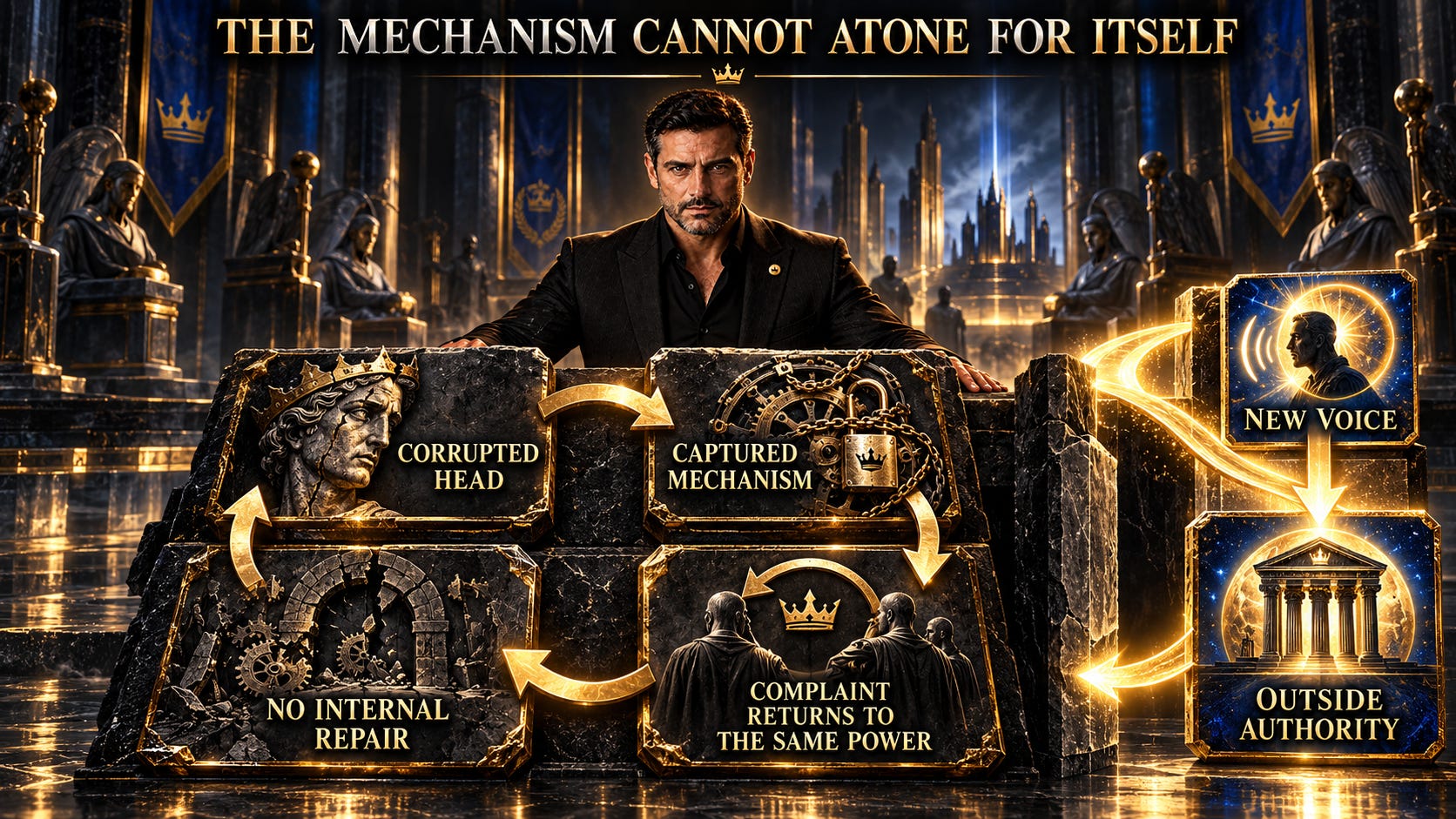
If the people controlling a system are also controlling how complaints against that system are received, investigated, interpreted, and resolved, the injured person is not moving through a remedy.
They are moving through a loop.
The complaint returns to the same power.
The evidence returns to the same authority.
The authority evaluates its own conduct.
Then the captured mechanism announces that it has found nothing wrong with itself.
This can happen inside a religious institution, a corporation, a family, a medical structure, a legal process, or any hierarchy whose internal review is controlled by the same head that benefits from the outcome.
This does not mean every internal process is corrupt. It means you must identify whether the process has enough independence to correct the people at its head.
When the mechanism has been captured, stop confusing repetition with escalation. Submitting the same truth through the same controlled channel will not necessarily produce a different judgment.
A new voice or outside authority may be required.
Editorial note: This is an interpretive spiritual teaching drawn from 1 Samuel 2–6. Prophetic and symbolic interpretations should not be treated as verified allegations about specific people or institutions. Evaluate real-world decisions through evidence, independent professional advice, and appropriate legal or safety processes.
© 2026 Claudia Quiana. All rights reserved. This original written decode, interpretive framework, terminology, structure, and accompanying visual concepts may not be reproduced, adapted, distributed, taught, or used commercially without written permission.

