

What looks like the truth is sometimes the story someone needed you to believe.
Emperor, you were handed a photograph.
The hair matches.
The clothing matches.
The body resembles the person you were told you were looking at.
The setting supports the accusation.
And because the subject has a past, the image appears to complete a pattern you already had reason to believe.
But look again.
You may not be looking at proof.
You may be looking at a performance designed to resemble proof.
This is not a declaration that every suspicious photograph contains a doppelgänger. It is an instruction to stop allowing resemblance, repetition, and reputation to do the work of verification.
Because in this case, the face may not be the only thing being substituted.
Someone may be attempting to substitute an entire identity.
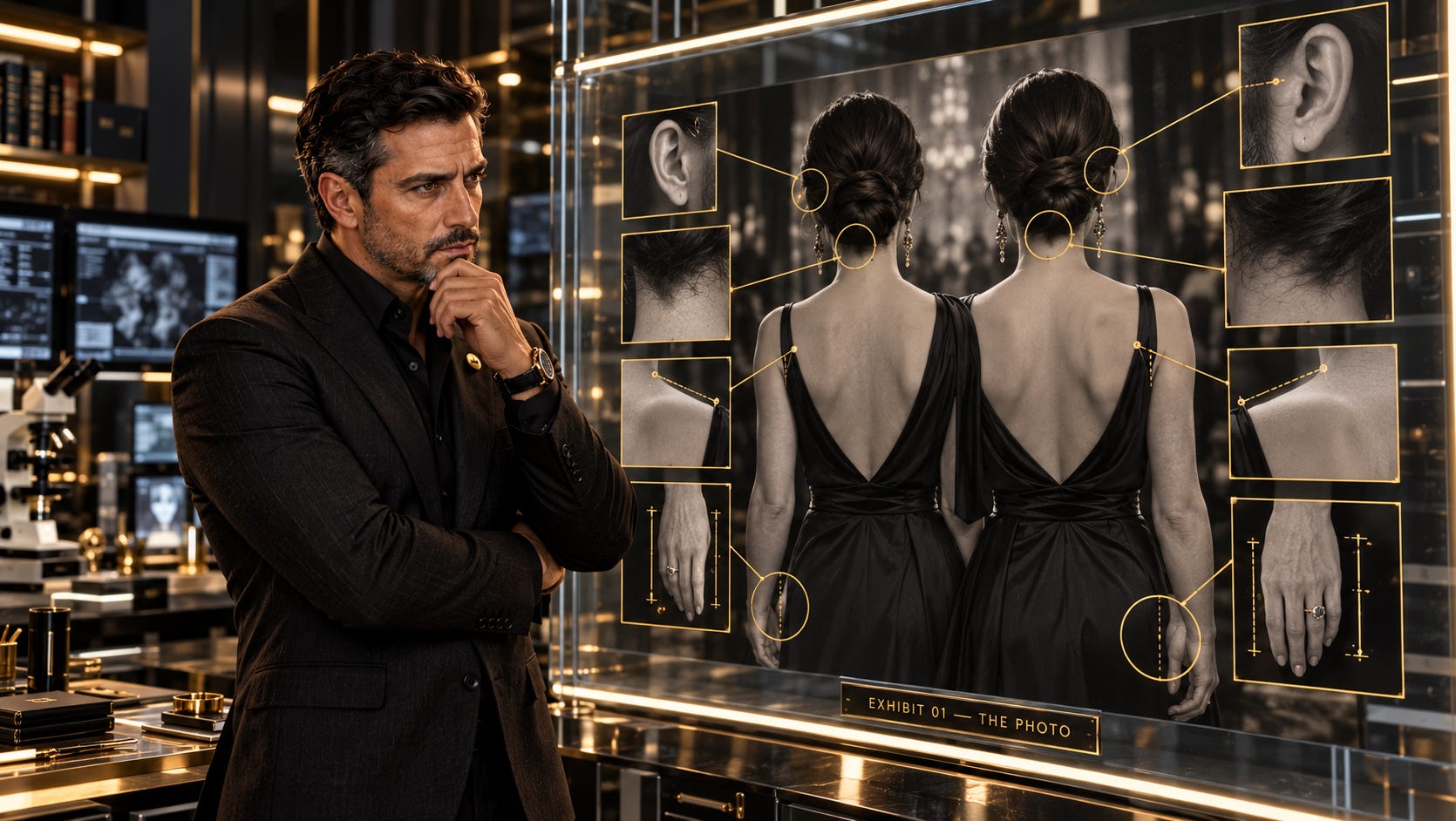
The photograph gives you recognition—not identification.
A photograph can feel conclusive before it proves anything.
The viewer recognizes the hairstyle, clothing, location, posture, or body type and mentally supplies the identity.
That process becomes even more powerful when the viewer already knows something damaging about the subject’s past.
The image does not have to prove the allegation independently.
It only has to activate the story already waiting in the observer’s mind.
That is the first mechanism operating here:
A recognizable image is being attached to a believable history.
But recognition is not identification.
A matching silhouette is not a verified face.
A familiar dress is not biological evidence.
A back angle is not confirmation.
A cropped photograph is not its original context.
A screenshot is not the source file.
Before you accept the image, determine what it actually establishes.
Is the face visible?
Can the photograph be traced to its original device?
Does the file contain intact metadata?
Was it edited, cropped, recompressed, or downloaded from another account?
Do the hairline, ears, hands, shoulders, gait, tattoos, scars, proportions, and facial landmarks belong to the person accused?
Or does the photograph merely give the viewer enough resemblance to finish the deception themselves?
The first contradiction: the past exists, but the continuity is missing.
The reading does not say the subject has no history.
The past may be real.
There may have been previous mistakes, former relationships, substance use, volatility, instability, poor decisions, or behavior the subject no longer denies.
That is precisely what makes the present construction effective.
A complete lie would be easier to reject.
This operation requires enough truth to make the false portion credible.
The distortion occurs when an authentic former version of the subject is used to manufacture a current pattern that the intervening years do not support.
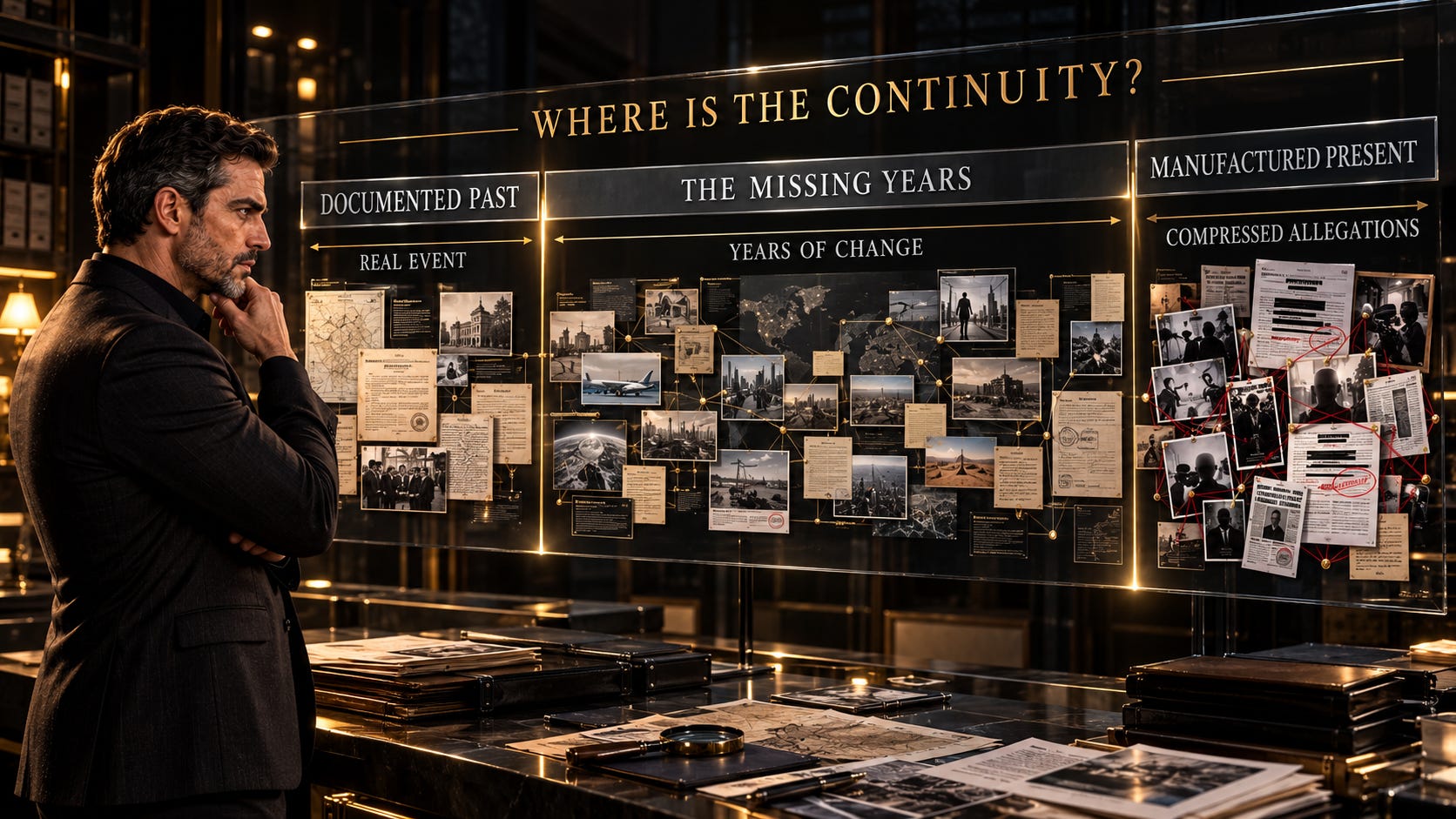
Ask for the middle.
What occurred between the documented past and this new allegation?
How did the person live during those years?
What did they build?
What responsibilities did they maintain?
What behavior changed?
Who actually witnessed that period?
Were the people now describing a “continuous pattern” present for the years between the old event and the new accusation?
Or did they arrive recently, retrieve a distant history, and attach a sudden cluster of incidents to it?
If the case moves from one old event, across years of change, directly into multiple compressed allegations, you do not yet have continuity.
You have a gap.
And someone may be using the subject’s reputation to conceal it
© 2026 Claudia Quiana. All rights reserved.
This teaching, decode, written framework, original terminology, charts, visual instruments, and arrangement are proprietary materials of Claudia Quiana and Basira Intuition TV.
No part may be copied, reproduced, republished, distributed, recorded, adapted, taught, or used commercially without prior written permission. Paid access is licensed solely for the subscriber’s personal use and does not authorize redistribution or republication.
Brief quotations may be used with clear attribution and a direct link to the original publication.


