


They call this trap impossible.
Not because no path exists.
They call it impossible because they calculated the energy you would need to survive it—and decided you did not have enough.
They studied the person you used to be. They measured your resources, your wounds, your relationships, your history, and the places where pressure once made you react.
Then they built the wall for that person.
Brick by brick.
A conflict you could not afford to fight. An accusation too large to ignore. A system already weighted against you. A public story designed to make you defend your identity instead of building your future.
They calculated the classical route.
They expected you to climb.
They expected you to fall.
But you were never only a stone.
You are also a wave—and part of you may already be standing on the other side.
The wall remains.
You do not.
That is the bet.
Before we enter: this is not spiritual bypassing
This teaching is not permission to ignore material danger, abandon legal or professional counsel, deny consequences, or pretend that conviction makes every obstacle disappear.
The wall can be real.
The cost can be real.
The system can be weighted.
The trap can have documents, institutions, witnesses, money, and collective agreement holding it in place.
Quantum tunneling is being used here as a structural teaching model: a way to examine what happens when the available classical route cannot carry you beyond a barrier—and why identity, attention, preparation, and sustained action change the route you are capable of taking.
This lesson is for the person who has already accepted responsibility for their choices. The person willing to heal, prepare, build, and confront the identity that helped create the position they are leaving.
Without that structural work, “the wall is not real” becomes delusion.
That is not this teaching.
The wall is real. The question is whether it belongs to the reality you are building.
The play was written before you arrived
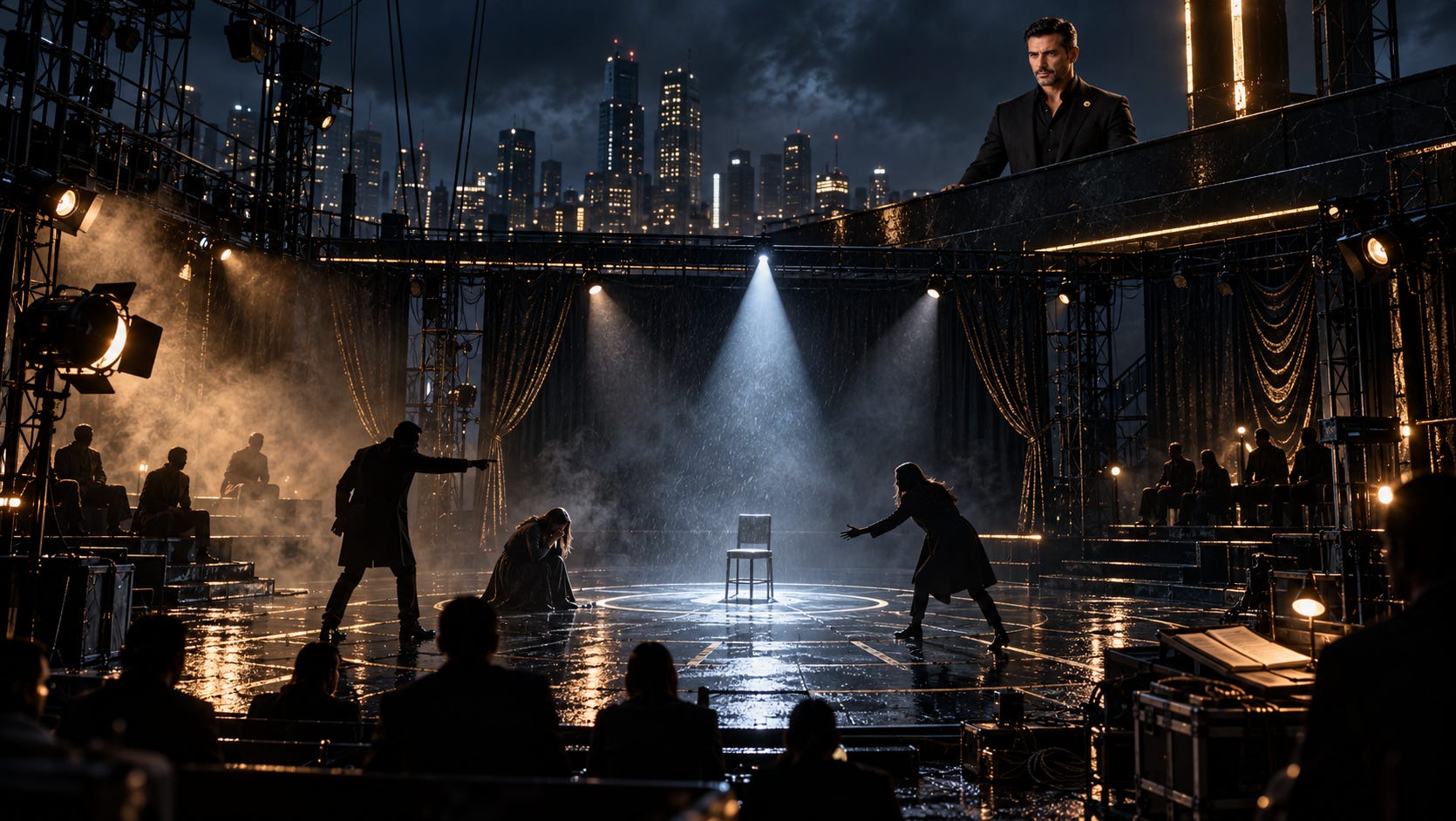
Every trap begins as a play.
The play has characters. Every character has a script. Every script has rules. And those rules belong to the world in which the play was written.
The accuser needs an accused.
The oppressor needs a victim.
The rescuer needs someone who cannot escape without them.
The audience needs a conflict to watch.
The moment you enter as one of those characters, you consent to operate inside the logic of the play—even when your assigned character is the one being wronged.
Especially then.
The wronged character is often the easiest to keep onstage because grievance creates attachment. You remain to prove what happened. You remain to receive an apology. You remain because someone must finally see that you were right.
But every hour spent proving your role is another hour spent inside the production.
The Emperor does not win by becoming the most convincing character onstage.
The Emperor becomes structurally external to the play.
Not the antagonist they expected.
Not the victim they prepared for.
Not the rescuer they intended to summon.
Not the witness performing for their audience.
The play begins to lose its grip because it has no position for what you have become.
This is not victory inside the narrative.
It is the dissolution of your relationship to it.
The trap is an attack on attention

The visible attack is rarely the complete attack.
The lawsuit, accusation, humiliation, interference, betrayal, financial pressure, or conflict may be real. But the deeper objective is often positional:
Convert your attention from forward construction into permanent defense.
If you spend the next year proving that you are not what someone called you, that year is no longer building what you were becoming.
The true loss is not only the money taken.
It is the time during which you stopped constructing.
The trap obstructs your view of the future so that you will choose your next move from fear in the present. Once fear becomes the state from which you decide, the trap does not merely block your destination.
It begins redirecting you toward the destination designed for you.
The future should function as a compass. You see the direction, return to the present, and act accordingly.
The trap attempts to replace that compass.
It places smoke in front of you and says:
You cannot move until this is resolved.
You cannot build until they understand.
You cannot become until the past releases you.
That is how attention becomes position.
And position becomes route.
The past is the anchor

A trap cannot be designed for the person you have not yet become.
Its builders require data.
They study your previous reactions. They use old relationships, inherited wounds, former identities, familiar fears, and people who remember who you were.
Then they place something from the past in front of your future.
They are betting that when the old wound appears, the old person will return to answer it.
That is the bet:
They are not betting that the wall is universally impossible. They are betting that you will still behave like the person for whom they built it.
If you once needed to be believed, they build an accusation.
If you once feared abandonment, they build isolation.
If you once reacted impulsively under pressure, they build urgency.
If you once required external permission, they position themselves as the authority capable of withholding it.
The trap is calibrated to coordinates you once occupied.
Its success depends upon finding you there again.
They built the wall for the classical version of you

The attack lands on the version of you the attacker modeled in their mind.
If you have moved structurally beyond that identity, the attack reaches a person who no longer exists.
The words may still be spoken.
The papers may still be filed.
The pressure may still arrive.
But the expected reaction does not.
They prepared for a victim who would defend.
An accused person who would perform innocence.
A frightened person who would surrender the future to control the immediate threat.
A wounded person who would need the audience to reverse its judgment.
When those reactions do not appear, the trap has struck an obsolete identity.
The mechanism activated.
The target was gone.
The question is not: “How do I defeat this wall?”
The first question is:
“Who does this wall require me to become in order for it to work?”
© 2026 Basira Intuition, Claudia Quiana. All rights reserved.
This teaching, decode, written framework, original terminology, charts, visual instruments, and arrangement are proprietary materials of Claudia Quiana and Basira Intuition TV.
No part may be copied, reproduced, republished, distributed, recorded, adapted, taught, or used commercially without prior written permission. Paid access is licensed solely for the subscriber’s personal use and does not authorize redistribution or republication.
Brief quotations may be used with clear attribution and a direct link to the original publication.


